Customers seem to wake up every morning asking, “What’s new, what’s different and what’s amazing?” In this hard pressed environment success comes from reading through the signals and knowing where to act. Sometimes a new product that surprises the market may be the answer. Most often than not “different” and “amazing” might just stem from a few but important tweaks in the customer experience. But here’s the thing — with an ever increasing array of touchpoints and interactions taking up place in the customer journey, even that minor tweak can become a major hurdle by itself. Let alone hitting the sweet spot across the board with a radically new product.
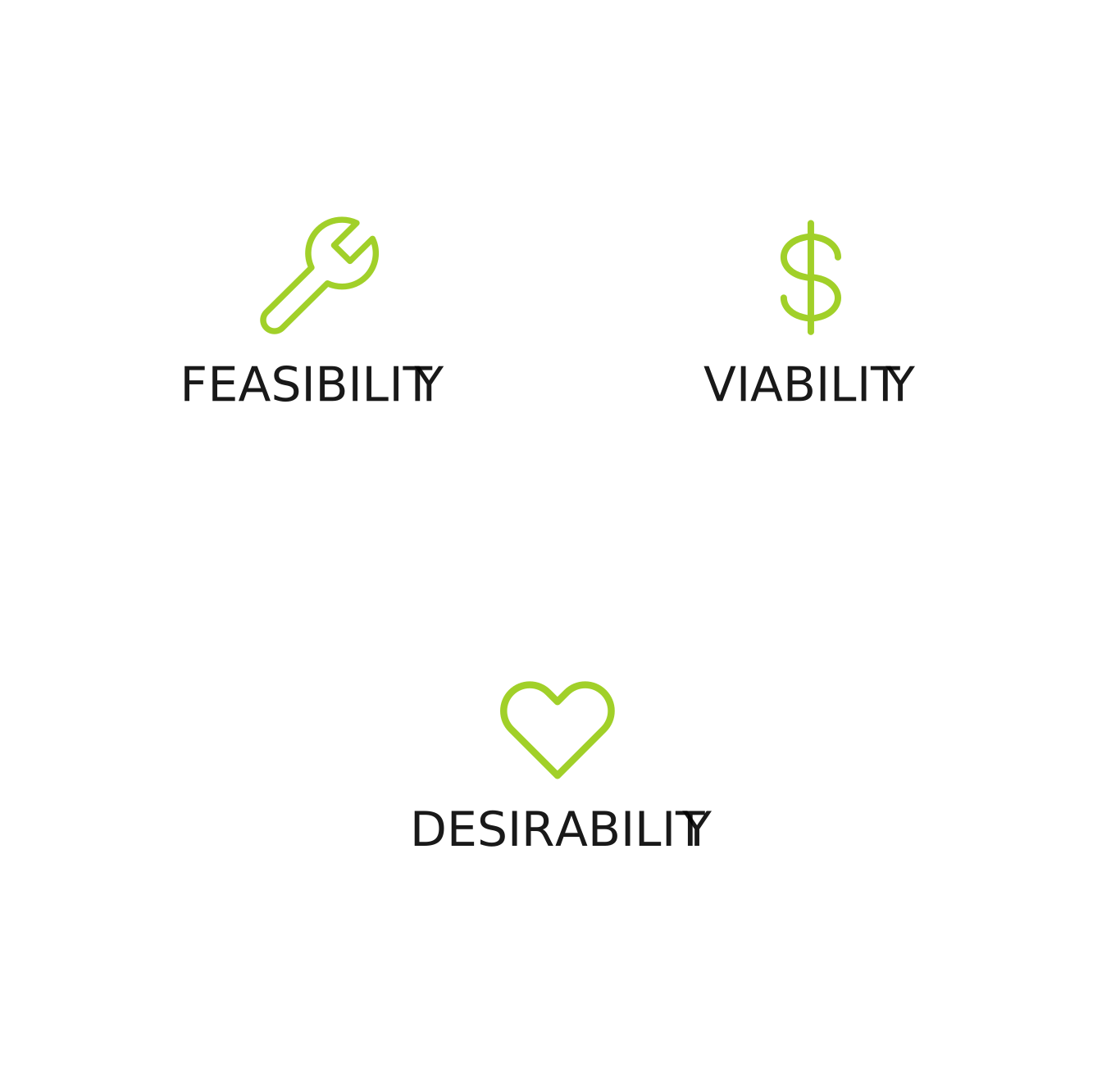
To prevent you from failing at the basics I take a human-centred approach to innovation known as Design Thinking. This approach puts the needs of people at the forefront for Desirability, integrated with the possibilities of technology for Feasibility and balanced with the requirements for business success for Viability. In broad strokes, here’s how it plays out:

Ask "Why" to understand the root reasons
As a child you overdone it. As an adult you probably killed it. Innovation begs for a beginners eye and an inquisitive mind ready to soak up the world. Awaken it! Need to be taken seriously? Say it’s as a foundational Six Sigma technique.
Apply a "Jobs-to-be-done" lens for assessment
Asking Why without a northern star can lead you astray. The Jobs-to-be-Done (JTBD) theory suggests customers hire products to do jobs for them and from there derive their needs. It’s a simple yet powerful way to make purpose tangible for all and, just as importantly, cared for.
Use outcome-driven syntaxes as connective tissue
Understanding customer needs is a semantic activity and demands a semantic model. I use outcome-driven syntaxes that connect upstream to business cases (value propositions) and downstream to execution (user stories) without letting the baton fall. In a domain so loosely patched together it’s important to have a system that caters for the handoffs.
Resort to ‘Maslow’ for the higher order
I behold Maslow’s Hierarchy of Needs as a reminder that what makes us human at the core can also be used to predict behaviour in the most unforeseen scenarios. It’s the higher order we can resort to when pushing the envelope of JTDB.
Scope trends for inspiration and validation
Could Uber have come out with JTDB alone? Unlikely. For that kind of foresight we need to keep an eye on what else is “picking up speed” — social trends, emerging technologies and new service experiences need to be held up while our instinct speaks up.

Every company is a bundle of skills and assets ready to be recombined. But what if the execution for that great idea goes beyond your grasp? Remember, in a networked world there are no boundaries to collaboration, so why not bundle up some partners and make it happen? In this phase we look into all the possibilities to make the New happen.

What will the return on the investment look like in the end? You will have to be able to reach your target customers, deliver to a large enough market, and at a price-to-cost ratio that makes the venture worth going for. What if this opportunity is a threat to an existing offering? Maybe it’s time to retire the old for the new. Or not. In any case, your problem is now having too many options instead of a few.




bespoke approach
Innovation is tough business. At the front-end sense-making is required while in the design of the service orchestrating the whole becomes as important as drilling down in the details. Understanding your customer’s needs is in that respect the very beginning. To explore all the possibilities of problem solving and opportunity finding your teams need to be engaged beyond that initial spark, grow confident and feel empowered throughout their way.
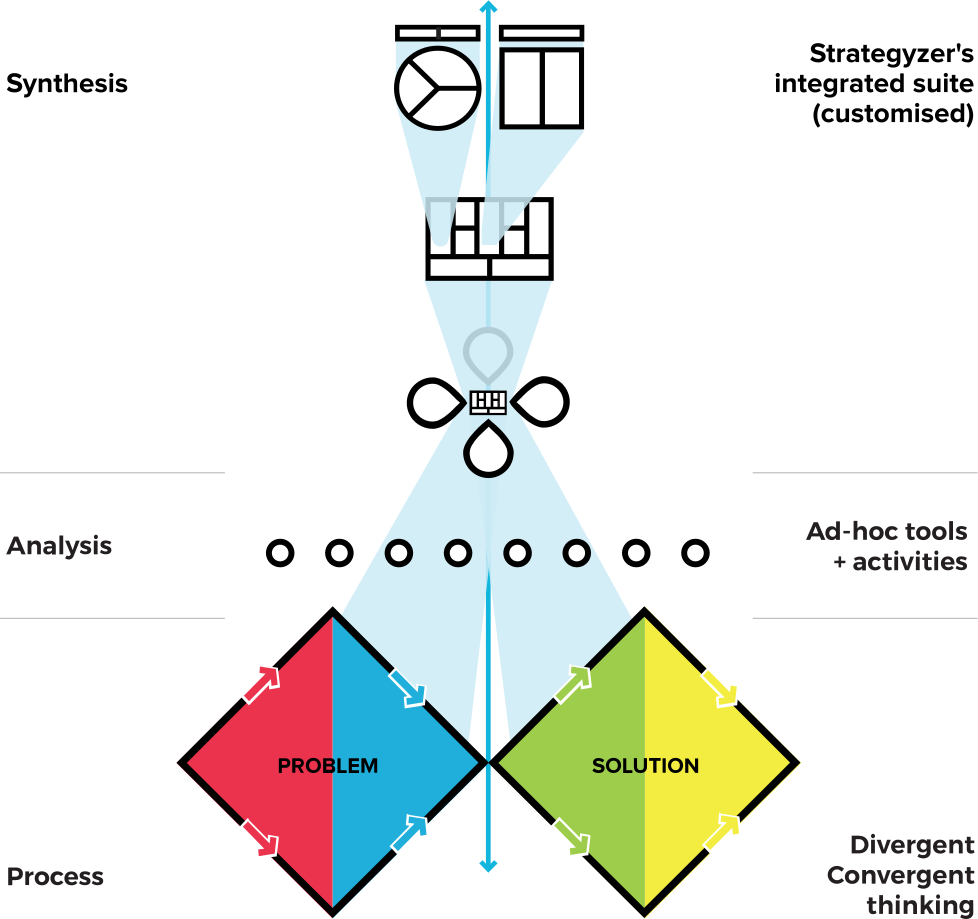
My framework was built on the back of established and emergent thinking to be a complete support system. One ready to contract or expand as the need arises, guiding action without prescribing, and helping set teams on time and on point within and among themselves. For the sake of simplicity, I have boiled it down into three abstraction layers:
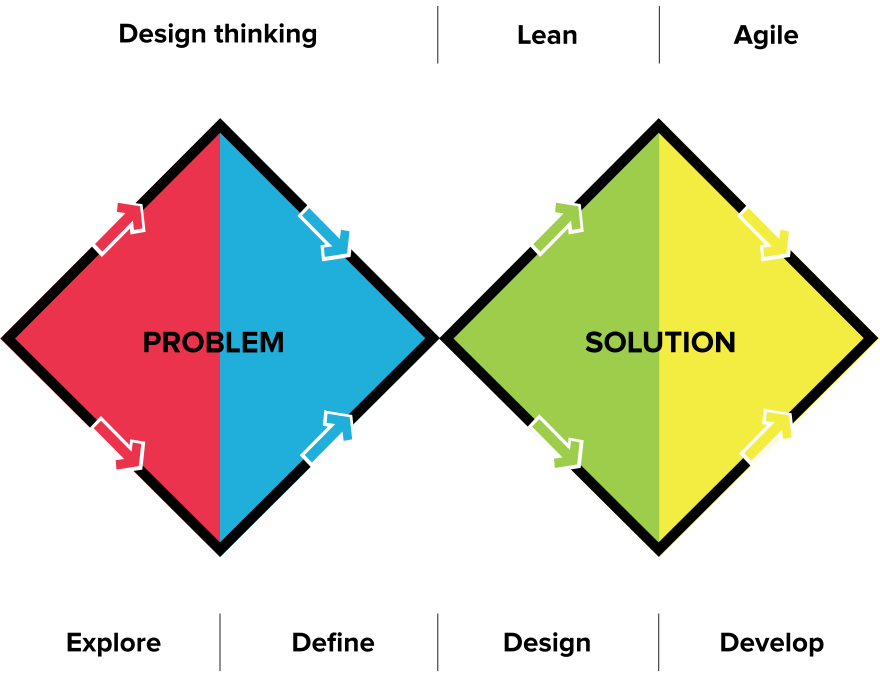
Although DesignThinking is in reality nonlinear and iterative it is possible to articulate an underlying process. The Double Diamond model from the UK Design Council is the one I found most fit for purpose:
- It splits the process in Problem and Solution spaces, which helps to keep in mind there’s an outcome to be attained.
- Marks Divergent and Convergent modes of thinking, so commonly overlooked in innovation.
In addition, the model remains flexible to mark dominant methodologies like Lean and Agile, or add phases without loosing integrity.
Ad-hoc tools + activities
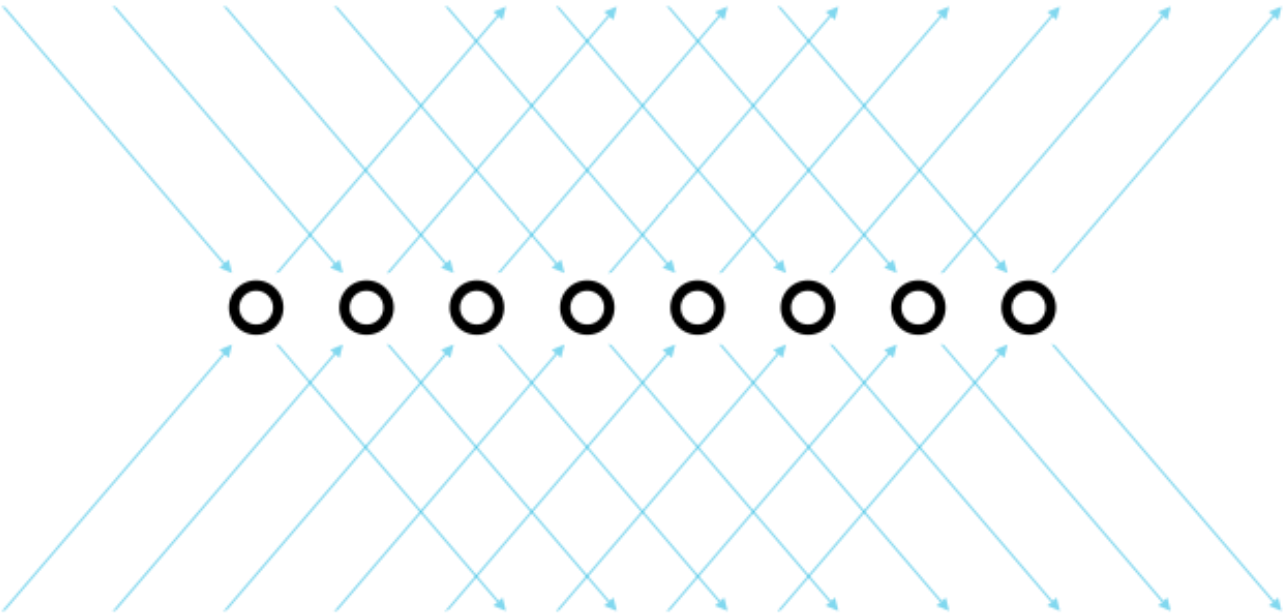
The middle layer represents the lion’s share of work, but also where an endless number of tools and activities can be employed without an absolute right or wrong way to go about it. Having said that, mapping the customer journey and blueprinting the service are mainstays. Other than that my rule of thumb is:
- Identify what is needed to learn and go with whatever makes sense.
- Just do what’s necessary. Everything else is waste.
- Communication beats documentation.
- Keep tabs on what’s current and new.
Strategyzer's integrated suite (customised)
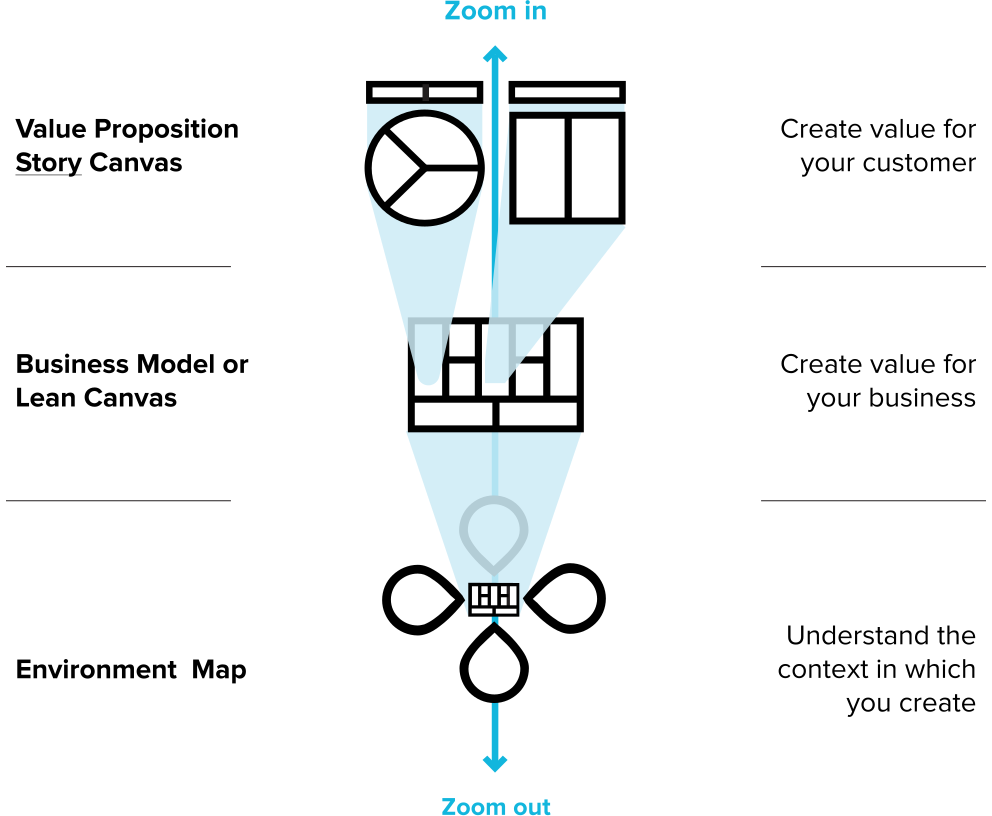
However important analysis is, synthesis is the holy grail. That’s why Strategyzer’s suite of tools sit at the top of my framework, albeit with a tweak of my own:
- Synthesis: They are visual and constrained, which force you to bring up the essential.
- Integration: They play out at different levels interfacing with each other.
- Alignment: They provide a common ground and shared language for value creation that both designers and non-designers can rally around.

Structure
In the end, it doesn’t matter if people are set off on the right foot or have stepping stones laid out for them. If they don’t want to make the walk nothing happens. To convince people who do not want to change to change we need to turn to Neuroscience and Evolutionary Psychology. They bring us an intriguing picture of three brains attempting to work as one in our decisions: the Reptilian, the Intellectual and the Emotional — holding the first as the culprit for resistance.
The reason being the Reptilian’s frontline duty to protect us from danger and pain. Since change isn’t reassuring, when faced with its prospect the Reptilian is quick to send negative tie-ins to the Emotional and cancel further reasoning from the Intellectual — calling the shots alone. And like so, people are disengaged without even knowing it.
This revelation defies the belief that our decisions are mainly logical or emotional when in effect it’s a primitive instinct that pulls the strings from behind the scenes.
For me it came down to this: Engaging those needed on board required a different approach from those already in. Building upon the work of communication experts Barbara Minto, Cliff Atkinson and Oren Klaff, getting others behind you takes a two-tiered approach:
1. Leading with the hook
The hook is the “chit-chat” you have to go through with your audience’s Reptilian before getting into the meat of the matter. As an introduction, it’s ruled by the search for a common ground between your interests and theirs, and tunnelling in through theirs. Take my own example from the homepage — it’s a mini story that holds you as the hero, your mission unwieldy, and me as the just-in-time ally:
- Setting: It’s crazy out there!
- Mission: And yet, you need to innovate.
- Pain: Envisioning the better future, testing the right ideas, and delivering real value is hard!
- Value Proposition: I come with the essential Expertise, Framework, Secret Sauce and Workbook (experience) to help out.
2. Following with the Pyramid Principle
Past the Reptilian, its then time to expound your arguments in both logical and emotional terms, but not without its own restrictions. Your audience still has to take those arguments in one by one, digest them, relate them, and hold them together. They will find the job easier if they come to them as a Pyramid, beginning at the top and working downward, because:
- The mind imposes order. Pyramidal structures allow for vertical and horizontal grouping.
- Working memory has limited handling capacity. Pyramidal structures serve the conclusion upfront, reducing cognitive overload.
- The mind is melodic. Pyramidal structures provide the protocol to flow from one point to the next without going wayward.
Pyramidal structures are the brain’s natural uptake, storage and retrieval scheme underlying both effective communication and thinking. As such, they are ingrained in the very fabric of the methods and tools I use to ensure that all meaning that is created is one that people can relate to and feel compelled to act upon. Even if that means prodding their Reptilian from time to time ;)

perfect
To change how teams work and win together.
My goal is neither to establish a hit and run operation nor to have you dependable at all times, but instead to plant the seeds for your team to raise the game on their own. For that we will work along Sprints, Projects, and Programmes designed custom to your needs. The option to have my skin in the game or one of your own coached in tandem is on the table. Prices will vary depending on the amount of work to be done, how quickly you want results, and your team’s availability.
A Sprint is the time and place to tackle a sticky problem, identify opportunities, kick-start or re-ignite projects. Outcomes may vary from high-impact proofs of concept to safe-fail learnings. Either way a sprint will get you unstuck and moving. Sprints take place within a few days to 2 weeks with engagements starting at €5K.
A Project starts with a sprint or picks up where one left off to focus on one area of importance and potential impact. Teams are lead through an organised process of releasing creativity and validating assumptions so the right concepts win all the way through execution. Projects are typically completed within 6-12 weeks and priced within the five-figure range.
A Programme is a long-term partnership to create alignment, build coalition, and sustain company-wide change. I work with your teams to develop a coordinated program of sprints and projects to drive impact at scale. Contracts typically range from 6 months to 1 year+.
Resident Innovation Catalyst — Coaching one of your own as Resident Innovation Catalyst should be the end game. The designated person will work alongside me and learn by doing with theory dispensed “just-in-time”. The Resident Catalyst option adds 30 to 50% overhead to the base Sprint, Project or Programme cost.

Design Services — When internal capacity is short I may double as a design executor or bring in an associate. Available per project.

Hello, I’m Ricardo. A problem solver at heart, industrial designer by training and a specialising generalist by experience in the digital realm. Having started on the agency side, I went to seek more significant problems with my consultancy Rapport and one and a half start-ups along the way. Altogether, I come with 15+ years helping companies serve an ever evolving customer through the combination of research, strategy, design and project management.
An essential premise of my work and personality is to understand what lies beneath the surface. Wading in ambiguous contexts I found my superpower: the capacity to bring new meaning to projects and purpose to teams with human-centred insights. To my woe, I also witnessed the most transformative instances being toned down because for too long innovation was unnecessary and risky.
Fast forward and the situation has taken an inevitable turn — innovation is now mandatory and can be de-risked.But, in the mad rush, I still see meaning and purpose taking the backseat to technology pushes and market pulls from the start; or failing to deliver due to teams becoming scatterbrained down the road.
That’s where I come in – leveraging my experience in the back-end with the best of what’s out there in innovation thinking I have of late revamped for a stewardship role across the board. It’s the outcome of trying to connect Design Thinking, Lean Start-up and Agile, only to realise that client teams lacked the connection themselves.
My proposition is thus simple — if you are struggling with innovation at the grass-roots or with disconnection among its parts I can help with an organic system of practice. As a bonus, you can dial how much of my skin is in the game or have your in-house catalyst coached in tandem.
Today is a great time to work this out.
Drop me a line!