Structure
In the end, it doesn’t matter if people are set off on the right foot or have stepping stones laid out for them. If they don’t want to make the walk nothing happens. To convince people who do not want to change to change we need to turn to Neuroscience and Evolutionary Psychology. They bring us an intriguing picture of three brains attempting to work as one in our decisions: the Reptilian, the Intellectual and the Emotional — holding the first as the culprit for resistance.
The reason being the Reptilian’s frontline duty to protect us from danger and pain. Since change isn’t reassuring, when faced with its prospect the Reptilian is quick to send negative tie-ins to the Emotional and cancel further reasoning from the Intellectual — calling the shots alone. And like so, people are disengaged without even knowing it.
This revelation defies the belief that our decisions are mainly logical or emotional when in effect it’s a primitive instinct that pulls the strings from behind the scenes.
For me it came down to this: Engaging those needed on board required a different approach from those already in. Building upon the work of communication experts Barbara Minto, Cliff Atkinson and Oren Klaff, getting others behind you takes a two-tiered approach:
1. Leading with the hook

The hook is the “chit-chat” you have to go through with your audience’s Reptilian before getting into the meat of the matter. As an introduction, it’s ruled by the search for a common ground between your interests and theirs, and tunnelling in through theirs. Take my own example from the homepage — it’s a mini story that holds you as the hero, your mission unwieldy, and me as the just-in-time ally:
- Setting: It’s crazy out there!
- Mission: And yet, you need to innovate.
- Pain: Envisioning the better future, testing the right ideas, and delivering real value is hard!
- Value Proposition: I come with the essential Expertise, Framework, Secret Sauce and Workbook (experience) to help out.
2. Following with the Pyramid Principle
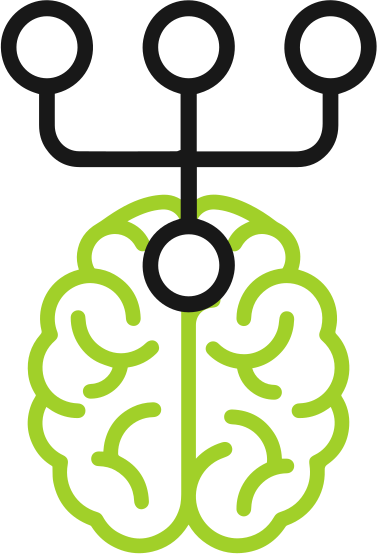
Past the Reptilian, its then time to expound your arguments in both logical and emotional terms, but not without its own restrictions. Your audience still has to take those arguments in one by one, digest them, relate them, and hold them together. They will find the job easier if they come to them as a Pyramid, beginning at the top and working downward, because:
- The mind imposes order. Pyramidal structures allow for vertical and horizontal grouping.
- Working memory has limited handling capacity. Pyramidal structures serve the conclusion upfront, reducing cognitive overload.
- The mind is melodic. Pyramidal structures provide the protocol to flow from one point to the next without going wayward.
Pyramidal structures are the brain’s natural uptake, storage and retrieval scheme underlying both effective communication and thinking. As such, they are ingrained in the very fabric of the methods and tools I use to ensure that all meaning that is created is one that people can relate to and feel compelled to act upon. Even if that means prodding their Reptilian from time to time ;)