Customers seem to wake up every morning asking, “What’s new, what’s different and what’s amazing?” In this hard pressed environment success comes from reading through the signals and knowing where to act. Sometimes a new product that surprises the market may be the answer. Most often than not “different” and “amazing” might just stem from a few but important tweaks in the customer experience. But here’s the thing — with an ever increasing array of touchpoints and interactions taking up place in the customer journey, even that minor tweak can become a major hurdle by itself. Let alone hitting the sweet spot across the board with a radically new product.
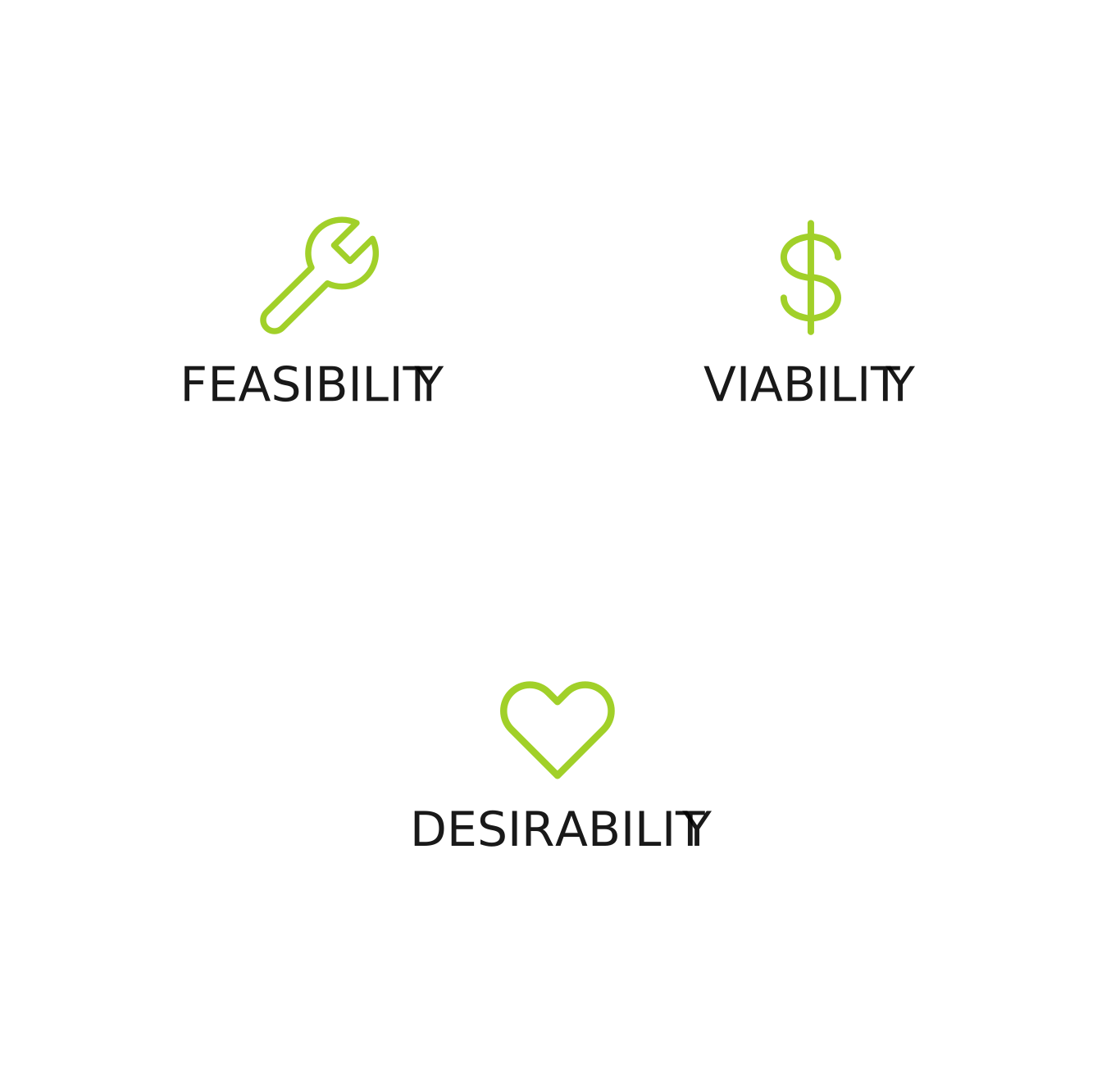
To prevent you from failing at the basics I take a human-centred approach to innovation known as Design Thinking. This approach puts the needs of people at the forefront for Desirability, integrated with the possibilities of technology for Feasibility and balanced with the requirements for business success for Viability. In broad strokes, here’s how it plays out:

Ask "Why" to understand the root reasons
As a child you overdone it. As an adult you probably killed it. Innovation begs for a beginners eye and an inquisitive mind ready to soak up the world. Awaken it! Need to be taken seriously? Say it’s as a foundational Six Sigma technique.
Apply a "Jobs-to-be-done" lens for assessment
Asking Why without a northern star can lead you astray. The Jobs-to-be-Done (JTBD) theory suggests customers hire products to do jobs for them and from there derive their needs. It’s a simple yet powerful way to make purpose tangible for all and, just as importantly, cared for.
Use outcome-driven syntaxes as connective tissue
Understanding customer needs is a semantic activity and demands a semantic model. I use outcome-driven syntaxes that connect upstream to business cases (value propositions) and downstream to execution (user stories) without letting the baton fall. In a domain so loosely patched together it’s important to have a system that caters for the handoffs.
Resort to ‘Maslow’ for the higher order
I behold Maslow’s Hierarchy of Needs as a reminder that what makes us human at the core can also be used to predict behaviour in the most unforeseen scenarios. It’s the higher order we can resort to when pushing the envelope of JTDB.
Scope trends for inspiration and validation
Could Uber have come out with JTDB alone? Unlikely. For that kind of foresight we need to keep an eye on what else is “picking up speed” — social trends, emerging technologies and new service experiences need to be held up while our instinct speaks up.

Every company is a bundle of skills and assets ready to be recombined. But what if the execution for that great idea goes beyond your grasp? Remember, in a networked world there are no boundaries to collaboration, so why not bundle up some partners and make it happen? In this phase we look into all the possibilities to make the New happen.

What will the return on the investment look like in the end? You will have to be able to reach your target customers, deliver to a large enough market, and at a price-to-cost ratio that makes the venture worth going for. What if this opportunity is a threat to an existing offering? Maybe it’s time to retire the old for the new. Or not. In any case, your problem is now having too many options instead of a few.